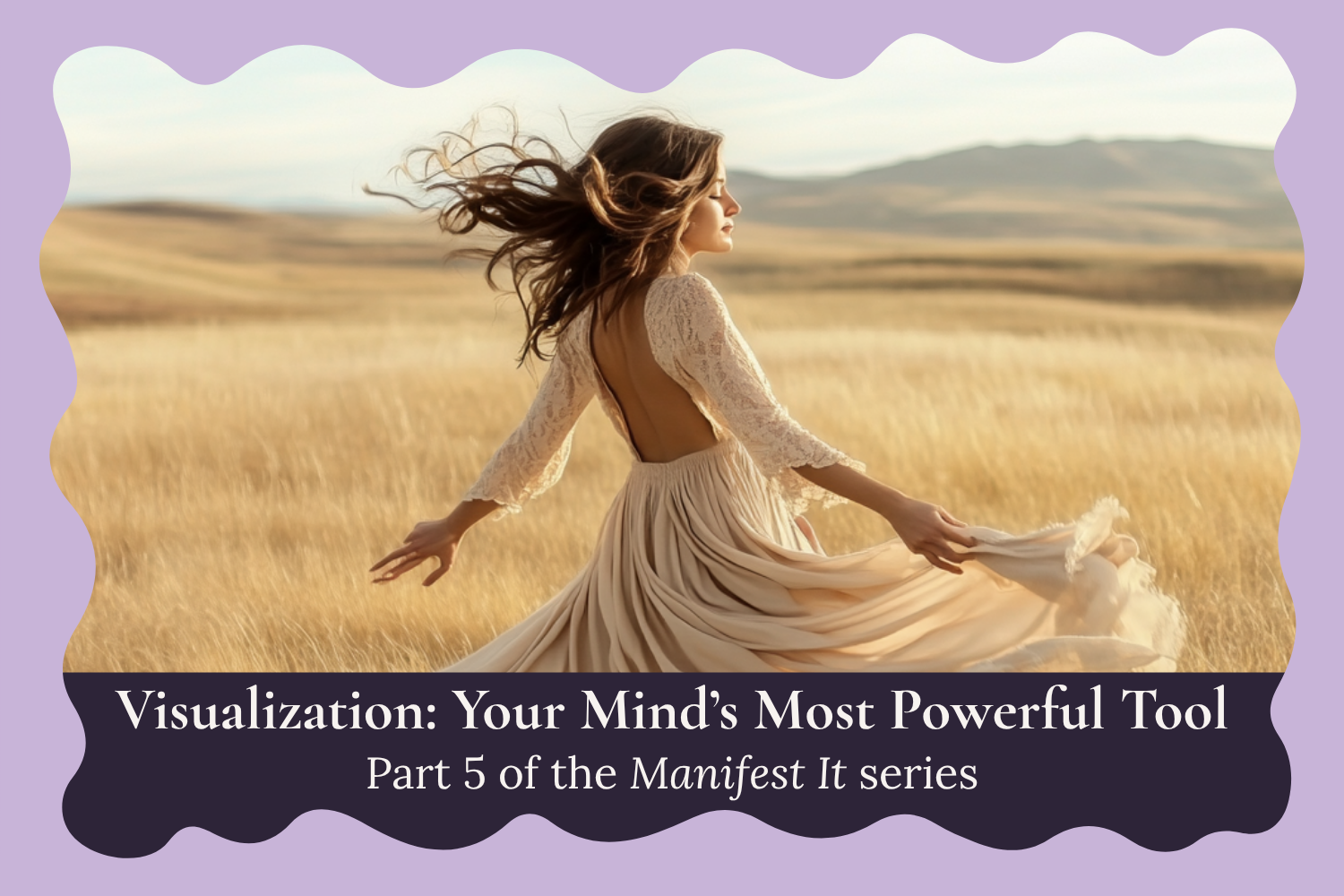
Visualization: Your Mind’s Most Powerful Tool
Post 5 of the Manifest It series
This isn't just a spiritual thing
Before we go any further, I want to tell you about Olympic athletes.
Not because sports is the point, but because the sports world gave us some of the most compelling, rigorously studied evidence for what we're about to explore. For decades, elite performers — gymnasts, sprinters, divers, tennis players — have used mental rehearsal as a core part of their training. Not as a supplement. As a cornerstone.
Michael Phelps famously visualized every race in precise, sensory detail — the feel of the water, the rhythm of his strokes, even what he'd do if something went wrong mid-race. He called it "watching his videotape." His coach called it non-negotiable.
Why? Because research has confirmed what top performers discovered through intuition: vividly imagining an action activates many of the same neural pathways as physically performing it. Your brain, in large part, cannot tell the difference between a vividly felt visualization and the real thing.
Which means that visualization — real, immersive, felt-sense visualization — is not daydreaming dressed up in spiritual language. It is brain training. And it is available to you right now.
Why it works (the fast version)
We covered this in Post 02 (check it out below), but it's worth revisiting here because it's so directly relevant to this practice.
When you consistently and vividly imagine yourself inside your desired reality, you're doing several things simultaneously. You're programming your RAS — your brain's filter — to recognize and surface opportunities that match that reality. You're laying down new neural pathways through neuroplasticity, making the desired future neurologically familiar. And you're rehearsing the emotional state of having what you want, which shifts your baseline expectation and, in turn, your behavior.
The more real it feels in your mind, the more your nervous system begins treating it as real — and acting accordingly. That's not wishful thinking. That's neuroscience working in your favor.
The most common mistake (and how to avoid it)
Before we get into techniques, let me save you from the mistake almost everyone makes when they start visualizing.
Most people watch their visualization like a movie. They see themselves from the outside — third person, like an observer looking at their own highlight reel. And while this is better than nothing, it is significantly less powerful than the alternative.
The goal is first-person, felt-sense visualization. You're not watching yourself receive the promotion. You are in your body receiving it — feeling your heart rate, hearing the words, noticing the wave of emotion, sensing the weight of the moment. Every sense engaged. Full immersion.
The difference between watching a dream and inhabiting it is the difference between imagining the smell of coffee and actually having a cup under your nose. One is abstract. One changes your nervous system. Aim for the latter every single time.

You are in your body receiving it — feeling your heart rate, hearing the words, noticing the wave of emotion, sensing the weight of the moment. Every sense engaged. Full immersion.
Three techniques to build your practice
Technique 1: The mental movie (your foundation)
This is where everyone starts, and when done well, it is genuinely powerful.
Find somewhere quiet. Close your eyes. Take a few slow breaths to settle your nervous system. Then step into your desired reality as if it's happening right now.
Where are you? What do you see around you? What sounds are present? What does it feel like in your body — not just emotionally, but physically? Is there warmth? Lightness? A sense of expansion in your chest? What are you doing? Who, if anyone, is with you? What are you saying or thinking?
Spend five to ten minutes here. Let it be vivid. Let it be specific. And above all — let yourself actually feel it. The emotional charge is what makes this work.

Technique 2: Scripting
Scripting is journaling from the future — and it is one of the most underrated tools in this entire practice.
Here's how it works: pick up your journal and write an entry dated sometime in the future — six months, a year, whenever feels right — as if you're looking back on how your desire unfolded. Write in past tense. Be specific. Include feelings, details, sensory information, the little moments you couldn't have predicted.
"I can still remember the morning I got the call. I was standing in my kitchen making coffee, and when I saw the number I had to sit down…"
Scripting works because it engages your imagination in a narrative, story-based way — which your brain finds deeply compelling. It also forces you to get specific in ways that pure visualization sometimes lets you avoid. You cannot write a vague script. The page demands details.
Technique 3: Vision boards — done with intention
Vision boards get a bad reputation, mostly because most people make them wrong. A collection of random aspirational images pinned to a board and then forgotten on the back of a door is not a manifestation tool. It's a mood board.
A real vision board is a curated, feeling-based anchor — a physical representation of the emotional states you're calling in, not just the objects or outcomes. Before you choose a single image, ask yourself: what feeling am I manifesting? Then select images that evoke that feeling in your body when you look at them.
Place it somewhere you'll see it daily. And when you look at it, don't just glance — pause, breathe, and let yourself actually feel into what those images represent. That's the practice.
Building a sustainable habit
The power of visualization compounds over time. A five-minute session done consistently every morning will outperform an hour-long session done once and forgotten. Start small and make it daily.
The best time for most people is first thing in the morning — before the noise of the day rushes in — or just before sleep, when your brain is already moving into a more receptive, theta-wave state. Either window works. Both together is ideal if you can manage it.
And on the days when it feels like you're just going through the motions? Do it anyway. The consistency is the practice. The feeling will follow more easily than you expect.
Your exercise
Using the intention you wrote in Post 04, spend five minutes on a first-person, felt-sense mental movie right now — before you close this post.
Use all five senses. Stay in your body. Feel the emotion of it. And if your mind wanders (it will), gently bring it back without judgment.
Then, sometime this week, try scripting that same intention as a future journal entry. Notice which format feels more natural, more alive, more yours. That's probably your anchor technique — the one to build your practice around.
Next up: Post 06 — Affirmations That Don't Feel Like Lies. Because the way most people use affirmations actually backfires — and there's a smarter, more honest approach that works with your nervous system instead of against it.

Disclaimers
The content provided in this article is intended for informational and entertainment purposes only and should not be considered medical, legal, financial, mental health, or professional advice. I am not a licensed healthcare provider, therapist, counselor, attorney, financial advisor, or other licensed professional.
Always seek guidance from qualified professionals regarding your specific situation, health concerns, recovery journey, or legal and financial matters.
Some links included throughout this website may direct you to products available for purchase through Hearthlight Studios. These products are shared because they align with the topics discussed and may help support the continued creation of content for this site.