The Quiet Wisdom of Mushrooms: what fungi teach us about our inner world
I didn't grow up thinking much about mushrooms. My earliest real memory of them is also my most dramatic one — a supreme pizza at a childhood birthday party that ended with a doctor visit and the discovery that mushrooms and I would simply never get along. After that, they only crossed my mind in the most mundane ways: rattled off in a list of allergies at a doctor's office, or spotted on a pizza at some kid's party that I'd have to politely eat around. They were, to put it plainly, the least interesting thing in my world.
But somewhere along the way — in my early twenties, deep in the unglamorous work of trying to understand myself — I started noticing them everywhere. Maybe that's the old adage proving itself true: you notice more of what you're working with, because your subconscious has quietly tuned in. Or maybe the universe, with its dry sense of humor, decided the girl who was allergic to mushrooms needed to pay closer attention to them. Whatever the reason, there they were. On nature walks. In art. In conversations about healing. In the quiet corners of cultures I'd never studied.
The more I looked, the more I found. And what I found wasn't about eating them or ingesting anything at all — it was about what they mean. What they have always meant, long before any of us were paying attention. I will forever keep my distance from the physical mushroom itself, but I have developed, in spite of everything, a genuine reverence for this strange little fungus that quietly surrounds us every day.
It turns out I'm not alone in this. Mushrooms have become, for many of us navigating the terrain of mental health, an unexpected symbol. Not because of any compound or substance, but because of what they represent — what they have always represented, long before modern science caught up with ancient knowing. There is something in the mushroom, in its strange and patient life, that speaks directly to what it means to be a person trying to grow.
This is my attempt to put words to that.
The Gift of the Dark: Transformation and Shadow Work
Here is something I find almost unbearably poignant about mushrooms: they do their most important work in the dark.

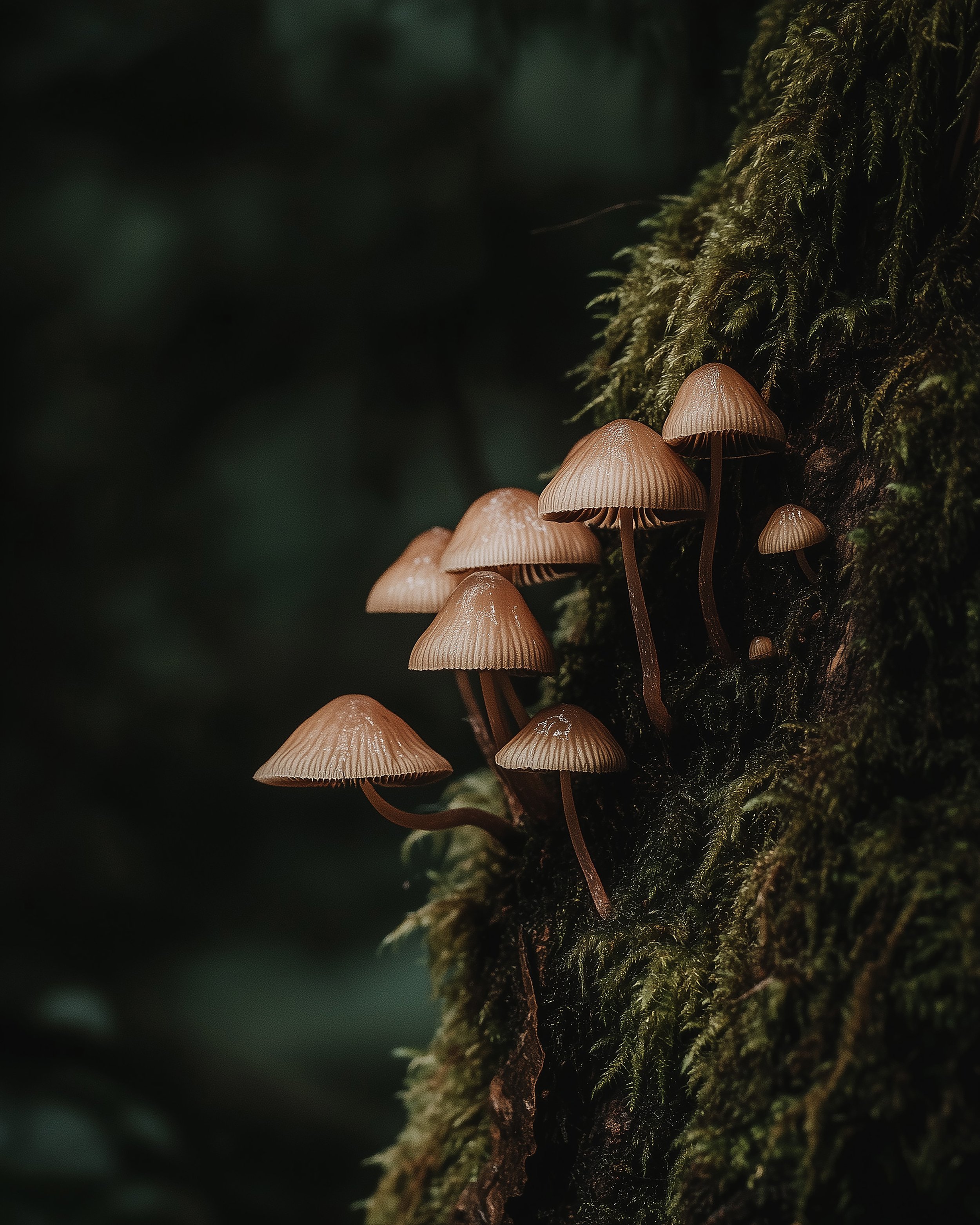
A mushroom doesn't begin as the thing we see. It begins in mycelium — a vast, invisible network of threads growing through soil, through rotting logs, through the deep and lightless ground. The visible mushroom, the part we recognize, is only the fruiting body. It's the end result of an enormous amount of quiet, underground effort. And it emerges, more often than not, from decay.
If you've ever done any shadow work — the psychological practice of turning toward the parts of yourself you'd rather not look at — you already understand this intimately. The process is not glamorous. It is damp and dark and it smells like the forest floor. You dig through things that have been decomposing for years: old grief, inherited shame, patterns you learned before you had language for them. You are not, for most of it, in the light.
But decomposition is not destruction. It is transformation. The mushroom knows something we sometimes forget: that what has died can become the very ground from which something new grows. The rotting log becomes a nursery. The darkest soil is often the richest.
Carl Jung, who gave us the language of shadow work, might have loved mushrooms for this reason. He understood that the parts of ourselves we bury don't disappear — they become the underground network, shaping everything from below. The healing, he believed, wasn't in cutting those parts out, but in bringing them into relationship with the rest of who we are. In letting them fruit. Letting them “flower”.
There is real comfort in this. The hard seasons are not wasted. They are, slowly and without fanfare, becoming something.
We Were Never Meant to Grow Alone: Interconnectedness
One of the most quietly revolutionary discoveries in recent science is what naturalists and indigenous communities have known for a very long time: trees in a forest are not competing in isolation. They are communicating. Sharing resources. Sending nutrients to struggling neighbors. And the network that makes this possible — the channel of connection running beneath the visible world — is fungal.
Mycelium connects root to root in what some have called the "wood wide web." A single teaspoon of healthy forest soil can contain miles of these fungal threads. The largest living organism on Earth is not a whale or a sequoia — it is a honey fungus in Oregon, a mycelial network covering nearly four square miles.
I don't think it's an accident that so many people who are healing from mental health struggles describe their recovery in terms of connection. Reconnecting to themselves. To other people. To something larger — nature, community, meaning. Isolation is one of the most consistent features of depression, anxiety, and trauma. The antidote, so often, is relationship.
The mushroom offers us a symbol for exactly this. Beneath the surface, beneath all the separateness we perceive, there are threads. Between us and the people we love. Between us and the ancestors we carry. Between us and the living world we walk through. We are more connected than we can see, and the health of one affects the health of the whole.
On days when the world feels particularly fragmented — when the news is heavy and the distances between people feel vast — I find something steadying in this image. The network is still there. It has always been there. It runs beneath everything.
A Spell for Good Fortune: Luck and Prosperity Across Cultures
It would be easy to assume that mushroom symbolism is a recent, Western phenomenon. It is anything but.
In China, the lingzhi mushroom — sometimes called the "mushroom of immortality" — has been revered for over two thousand years as a symbol of health, longevity, and divine favor. It appears in traditional paintings, royal iconography, and medicinal texts. To give someone a lingzhi was to wish them a long and flourishing life.
In parts of Central Europe, finding a mushroom — particularly a fly agaric, the iconic red-and-white spotted variety — was considered a sign of good luck. These mushrooms appear on German and Austrian New Year's cards to this day, tucked beside four-leaf clovers and horseshoes, cheerful little omens of prosperity.
In Japan, the matsutake mushroom carries deep cultural significance, associated with autumn, abundance, and the bittersweet passage of time. It is a gift given with care, a presence on the table that signals something important is being marked.
What I find tender about this thread is how many cultures — independently, across centuries and continents — looked at this strange, fleeting, otherworldly thing growing from the earth and thought: That is lucky. That is a blessing.
There is something we can borrow from this, I think. The idea that good things can come from unexpected places. That abundance doesn't always look the way we imagined. That a blessing might appear quietly, overnight, in a place you weren't looking.
Where the Map Ends: Magic, Folklore, and the Unknown
And then there is the other thing mushrooms have always carried: magic.
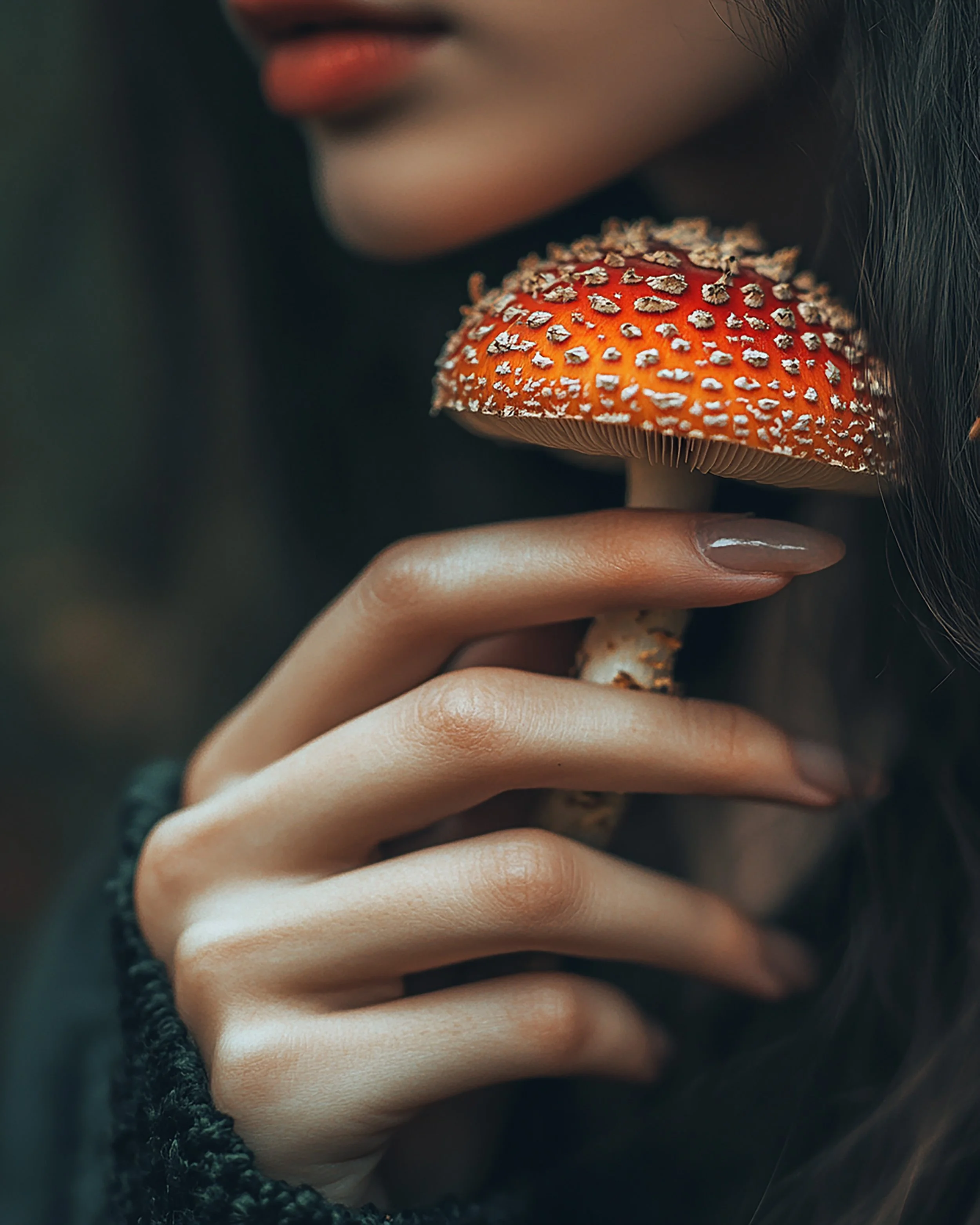
Fly agaric, the red-capped, white-dotted mushroom of fairy tales, appears in folklore across the Northern Hemisphere — in Siberian shamanic traditions, in Scandinavian legend, in the illustrated pages of Victorian children's books where it serves as furniture for fairies and meeting places for elves. Alice sat beside one and had a conversation that changed everything. Smurfs built their houses out of them.
There is a reason the mushroom appears so reliably at the threshold of the magical world. It grows in rings — "fairy rings" — that seemed to our ancestors like portals, like places where another world had briefly pressed against this one. It appears overnight, as if conjured. It vanishes just as suddenly. It exists in the liminal space between the plant world and something harder to name.
Mental health, too, often asks us to stand at thresholds. To enter the unknown parts of ourselves. To sit with mystery, with the questions that don't have clean answers, with the parts of experience that resist being fully mapped or explained. Grief does this. So does healing. So does the long, strange work of becoming more fully yourself.
The mushroom, I think, is a symbol for the willingness to enter that uncertain ground. To say: I don't know exactly what is here, but I am going to look anyway. To trust that even in the fog, in the dark, in the not-yet-knowing, something is growing.
A Small, Stubborn Hope
If you had told me, in that hard season I mentioned at the beginning, that I would one day find genuine comfort in thinking about fungi, I would have looked at you strangely. And yet here we are.
What mushrooms have come to mean to me is something like this: transformation is possible even in the dark. We are more connected than we appear. Good things can arrive in unexpected forms. And there is more to this life than what we can see.
These are not small things. In fact, they might be the things that matter most.
The next time you see a mushroom — on a forest walk, in a painting, on a piece of pottery — I hope you pause for a moment. Not for any mystical reason, but just to remember what it knows: that growth happens underground. That the network holds. That strange and beautiful things emerge from places we weren't watching.
That is, I think, a very good thing to remember.
Subtle Reminders
I believe in surrounding yourself with symbols that remind you of what you're working toward. That's actually the heart of everything I create at Hearthlight Studios — small, everyday objects that carry quiet messages with you, such as the mushrooms. A journal to do the inner work in. A bookmark to hold your place. A keychain to keep the reminder close.
Disclaimers
The content provided in this article is intended for informational and entertainment purposes only and should not be considered medical, legal, financial, mental health, or professional advice. I am not a licensed healthcare provider, therapist, counselor, attorney, financial advisor, or other licensed professional.
Always seek guidance from qualified professionals regarding your specific situation, health concerns, recovery journey, or legal and financial matters.
Some links included throughout this website may direct you to products available for purchase through Hearthlight Studios. These products are shared because they align with the topics discussed and may help support the continued creation of content for this site.